
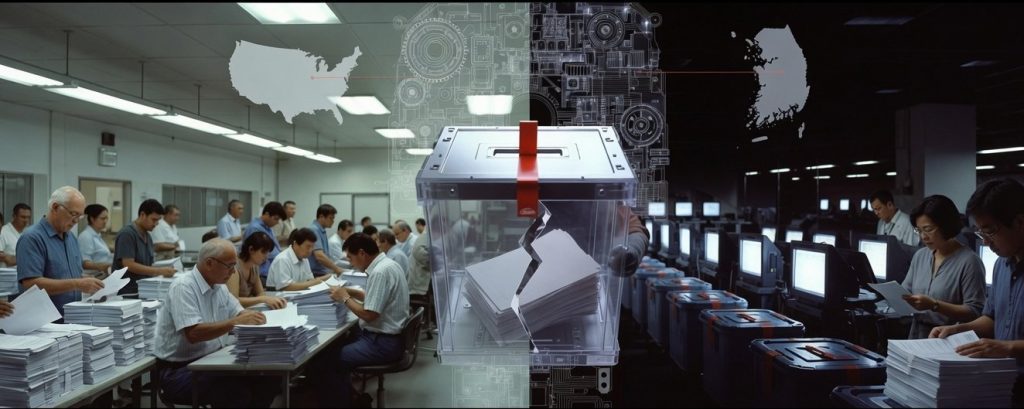
If someone wanted to make widespread election manipulation easy to carry out yet nearly impossible to prove, what system would they design?
Imagine you wanted to create conditions where large-scale interference could happen with minimal risk of detection or proof. You would not need to control every polling station or bribe every worker. You would simply engineer the system itself so that any problems could be explained away as honest mistakes while the paper trail became impossible to verify after the fact.
The ideal system would have these features:
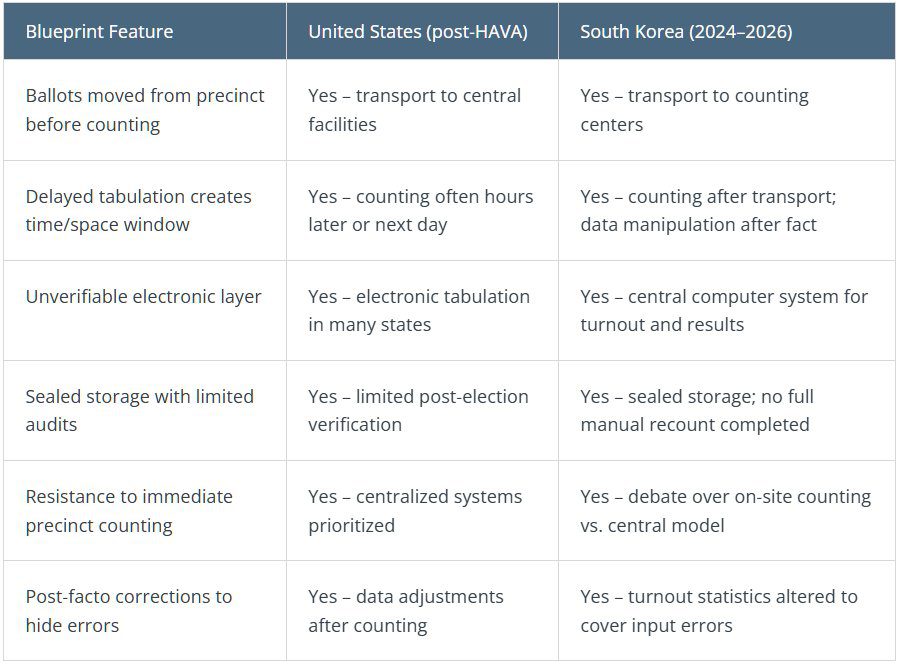
- Move ballots away from the precinct where voters cast them before any counting occurs, creating a window of time and space where no one is watching and manipulation can take place without immediate detection.
- Delay tabulation for hours or until the next day, so any changes can occur between the moment votes are cast and the moment they are officially recorded.
- Rely on centralized counting facilities and electronic systems that are difficult for the public to audit in real time, making independent verification nearly impossible.
- Store ballots under seal with limited independent oversight, so any problems can be explained away as honest administrative errors.
- Make full manual recounts rare, expensive, or politically blocked, ensuring the system never has to prove the ballots still match the reported totals.
- Ensure that any discrepancies can be attributed to administrative error rather than deliberate interference.
- Create a system so complex that citizens, election officials, and legislators cannot fully understand how it works, making independent oversight nearly impossible.
- Use media narratives, controlled distractions, and targeted discrediting of prominent voices to dismiss or poison anyone who points out discrepancies, so legitimate concerns get buried under noise or guilt by association.
- Demonize prominent voices through media attacks and loaded language so that people automatically dismiss anything they say without ever examining the evidence.
- Infiltrate or create organizations that appear to champion election integrity, then collect evidence and donations from concerned citizens while quietly doing nothing with them, so the movement burns out from within.
- Promote individuals who fail to grasp the full scope of the problem while suppressing those who understand it, so the public debate remains shallow and misdirected.
This is not just a theory; it is a checklist of structural features that would make covert manipulation easier and harder to disprove.
United States
In the United States, the Help America Vote Act of 2002 accelerated exactly these changes. It pushed states toward centralized, computerized voter registration systems and electronic tabulation in many jurisdictions. Ballots are often transported from precincts to central counting locations, and counting frequently occurs hours after polls close or the next day. Local citizen oversight at the point of casting and immediate counting was reduced in favor of statewide systems that create larger single points of failure. Once ballots leave the precinct, any later recount rests on an assumption of unbroken chain of custody that can no longer be guaranteed as publicly observable in real time.
South Korea
South Korea followed a parallel path, but the timeline is staggered. In the April 2024 parliamentary election, the conservative side suffered a narrow defeat and immediately raised allegations of widespread fraud and North Korean cyber interference. These claims became the explicit justification for President Yoon Suk-yeol’s declaration of emergency martial law on December 3, 2024. Troops were deployed to the National Election Commission and the National Assembly. Parliament voted unanimously within hours to lift the decree, Yoon rescinded it before dawn, and he was later impeached, removed by the Constitutional Court, and convicted of rebellion.
Then came the June 2026 local elections. Ballot shortages were reported at polling stations nationwide, with voting temporarily suspended at some locations. Additional ballots were supplied, but many lacked preprinted serial numbers and were delivered unsealed without multi-party escorts. After the fact, investigators discovered that National Election Commission employees had manipulated real-time voter turnout statistics in the central computer system to cover up input errors—allocating discrepancies across multiple stations so the reported numbers would match. A joint prosecution-police task force raided NEC headquarters in July 2026 to secure evidence. No full hand recount of the affected ballots has been completed to close the chain-of-custody question.
The Parallel
The same structural features appear in both countries: centralization, delayed verification, post-facto data corrections, resistance to immediate precinct counting before ballots ever move, attacks on and demonization of anyone who questions. The pattern is not isolated to one nation or one election cycle.
The question that remains is simple and unavoidable: What level of access and coordination would have been required to install every piece of this system across legislation, bureaucracy, courts, and media—quietly, over time, so people would not notice the change until it was complete?

