The Misleading Claim That Machines Are More Accurate Than Hand Counts

Signature: gD0D5KQpxAL0a4p4X4UtcHsLUHpvKidb4fEc2dKWOQgdqwXSWk+uCT4RBAPuZ9gOE0Owd1cdPNYZQAwDZ8HZfbc18vdSvJE3D7WkZn10ujE9ozJTKFjDGnn/xMyGWn0f/XOJ+T4Dnx1cQC4a7gCcCY1m2s6r4QQjhBG117/XIi5AW9+zIV560sqamcnjmsNnnM/GwuSiAlD8t1xyfA7Qk/w/rAN85TKILtEUmaPpZCFH2xWCfKrEBFsXB90LPY6u9zEPKSf1sm0yEiZdpp4quChTQ0rl5SGcac4jEJMHwMzajy0nINOclpFAvYsJqKgvVeOxF1/GwVTtTxb8etOho69s1ZjMf10f6DjVvCU321TEUu8B4nk80gR/knPv2Ohi6dq9zqcOhvh+gsXVdlTADfpLcBC6TJobogwgCjHaol9t3GYONp1J7x3CPW4Rk8QyO+7Fyy/yCuRQR8Mil+la0FEbsEGlCoZAI7pj4YTJED9MXYu8ZIvNvnFrSzBLR2iPoGLUpI7DbyGyDcj0ELMKSdMnBaj2ynKg5baVXBwaV4SZMdQVoUCX0vJ4+fohAOuZFKgu1bZDCWAmLvhUusSJChMEGH/CkKzwm3orniAfd6fO3TxgaF04OoF9LjgD0VsrJaDV3KEJmn461kcE49bGPPXjSSDUJFoolNJ0nMneo4GlSC5uM0KYrGUDD5FKFmJ0sDuZ90TKLqguHhCZYG84P3DW2kTSETf2ZbpC9D3ZrszYRVQ4Z8vBZhLVB3QnRgNk6o6eYQK2wEV6ph+9uCEAtTdQGU3llYObjr2cDoD4oqHPDB9Qf2NPpZ5UNfiVO9wEO9tTBy1EflhyvgHDzuUg1+XLyC7ELshU1bTR+v5uQygGP+CCCH+z515jr60zHvW8amSHwJFwSuCEwLTa1yNHs+3GqWJZm5q/FU2CaSIwUrviKqTksk9S2sWk6YWaX8nXY5Us348ZEf3rP3GYKriYcNX+43wPrtPzbU5qmQxbju0=

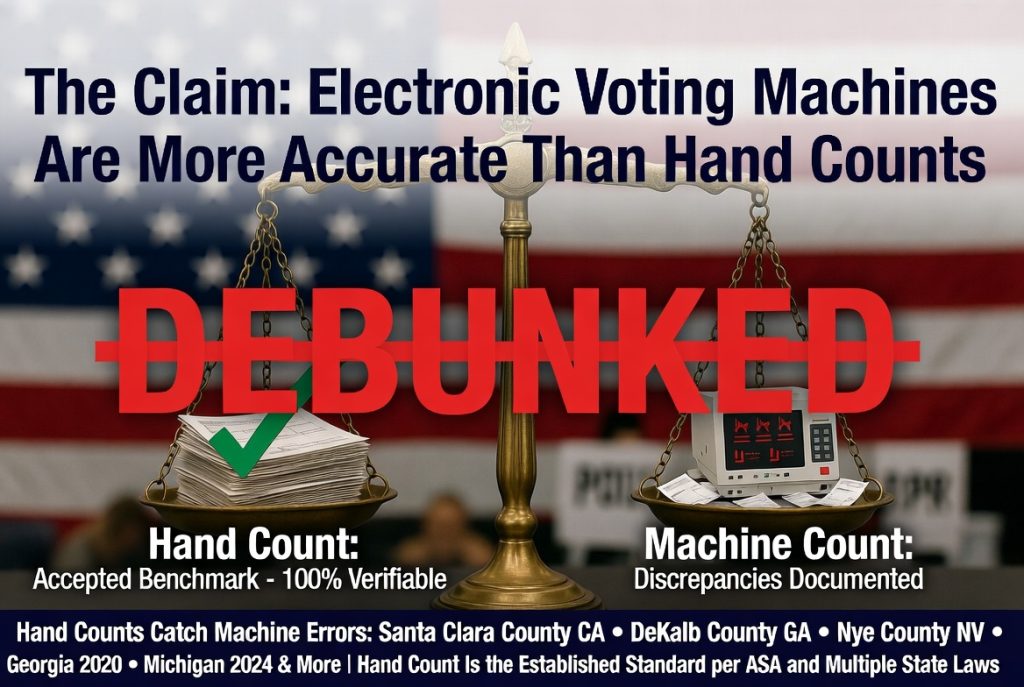
For years, organizations such as the Brennan Center for Justice, the Voting Rights Lab, the Bipartisan Policy Center, and others have promoted the narrative that electronic voting machines are more accurate than hand counting. This claim rests on flawed circular reasoning found in multiple academic studies.

A key example is the 2018 study “Learning from Recounts.” The researchers observed that when ballots originally counted by machine were recounted by machine, the average discrepancy was ‘only’ 0.13% to 0.15%. (That alone should raise alarm bells, that machines can’t even count votes accurately back to back). Then they go on to say when the same ballots were counted by hand, the discrepancy ‘increased’ to 1.8%. Rather than admitting that the machines had failed to accurately tabulate the ballots, the authors preposterously (mis)interpreted the larger gap as evidence that hand counting is less accurate.

This reasoning is absolutely fundamentally flawed. The American Statistical Association, in its official 2018 document “Principles and Best Practices for Post-Election Tabulation Audits,” clearly states:

“The benchmark of tabulation accuracy is what an accurate hand count of all ballots accepted for counting by the election authority would reveal.”

In other words, a proper hand count is the accepted standard against which machine accuracy must be judged. Several states reinforce this principle in their election codes. For example, Georgia’s risk-limiting audit law (O.C.G.A. § 21-2-498), Texas Election Code provisions, and the audit statutes in New Mexico and Minnesota all rely on manual hand counts of ballots to verify machine results. When discrepancies appear, the hand count serves as the de-facto reference point.

Some real-world examples where hand counts caught discrepancies in the original machine count:

  • Santa Clara County, California – 2024: Hand review found 19 ballots that were never counted originally.
  • Michigan statewide – 2024: Risk-limiting audit hand count of 119,567 ballots found a total discrepancy of 33 votes (0.03%).
  • DeKalb County, Georgia – 2022: Machine tabulators showed her with zero votes in most precincts. Hand recount revealed she was shortchanged by 3,792 votes.
  • Nye County, Nevada – 2022: Hand count caught votes missed by machines due to a 5% sensitivity threshold. The clerk stated the hand count was the more accurate result.
  • Georgia statewide – 2020: Full hand audit found approximately 5,000 ballots that had not been tabulated in the original machine count.
  • Iowa 2nd Congressional District – 2020: Hand-involved recount corrected 168+ votes and flipped the election outcome.
  • Ware County, Georgia – 2020: Hand audit found 37 additional votes not counted by the machines.
  • Butte County, Idaho – 2020: Hand audit found 9 extra votes missed by machines due to ballot sorting errors.

These cases demonstrate that hand counts have repeatedly identified errors that machine tabulators missed. Yet many studies and institutions continue to treat larger discrepancies between machines and hand counts as proof that hand counting is inferior, rather than acknowledging that the machines failed to match the established hand-count benchmark.

When two independent counts of the exact same ballots produce materially different results, logic dictates that at least one of them is inaccurate. The data consistently shows that machine counts frequently fail to match the hand-count standard.

The public deserves an honest assessment of these systems. The claim that machines are inherently more accurate than hand counts is not supported by either the data or the proper application of the accepted verification standard.

This pattern of deceptive research has persisted for years. Studies repeatedly use hand counts as the benchmark to test machines, then flip the results to claim the benchmark itself is flawed. This is not science — it is statistical sleight-of-hand designed to manufacture a predetermined conclusion. By citing these misleading studies, major institutions and election officials have deliberately undermined public confidence in hand counting while protecting the very systems that have repeatedly failed when measured against the hand-count standard. This is not science. It is statistical deception designed to protect flawed machines while discrediting the very method used to verify them.

The A-Count-Able Hand Count Tabulation Process produces a 100% Verifiably Accurate result, and is simple enough for a 6-year old to understand and perform. The argument is OVER. It’s time for common sense to be the adult in the room.


Engineered Asymmetric Ideological Capture

I used to be a Democrat. For many years—longer than I have been a Republican—I voted blue and supported the party’s goals of fairness and progress. However, over time, the party shifted. It moved far to the left, beyond where I stood. I did not change my views; the party changed around me. Ideas that once felt shared now seemed distant. Policies pushed further. Voices that disagreed were sidelined. I left the party and became Republican. I hoped for balance. Yet I soon noticed the same pattern: infiltration. It was not loud or obvious—just quiet control. Conventions used rules to sideline real candidates. Staffers nodded agreement but undermined from within. Both parties, I realized, serve as mechanisms. They herd voters, select winners, and allow subtle manipulations in elections. This is why the topic matters to me. It is not about left against right. It is about who above them truly holds power. And how ‘they’ have taken over our nation, one layer at a time.
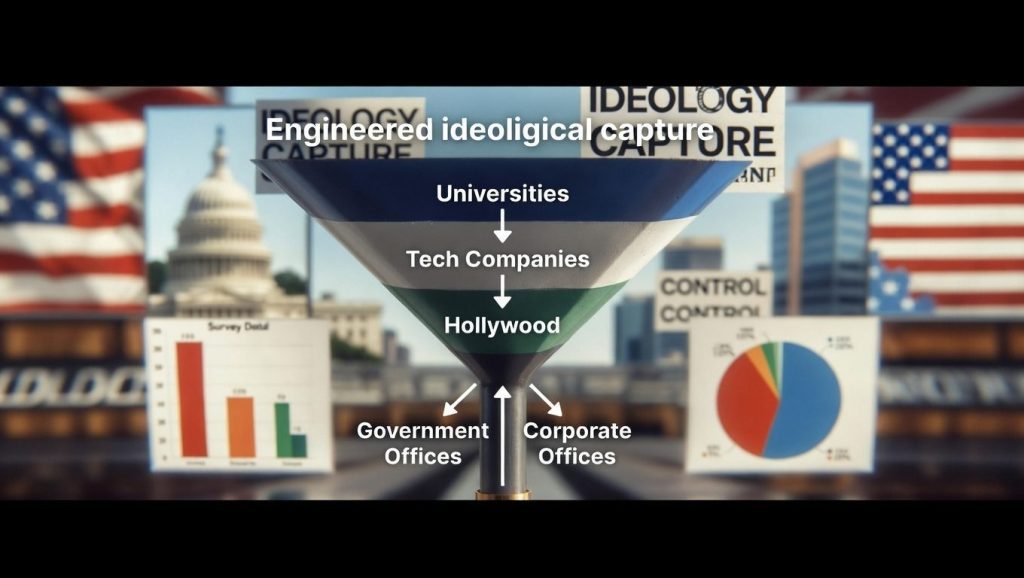
Picture a funnel—like those used in marketing or hiring. At the wide top, anyone could apply. As it narrows, filters appear. Certain words, certain backgrounds, certain signals decide who advances. At the bottom, only one type emerges. That is not chance. That is intentional design. Across America—from universities to tech companies, Hollywood studios, government offices, even congressional staffs—this funnel shapes who and what gains influence. I call it Engineered Asymmetric Ideological Capture (EAIC). Radical views replace others, generation by generation. Not through open quotas—just smart, hidden layers. Pipelines prepare people. Screens weed out dissent. “Fit” checks look neutral but favor one side.

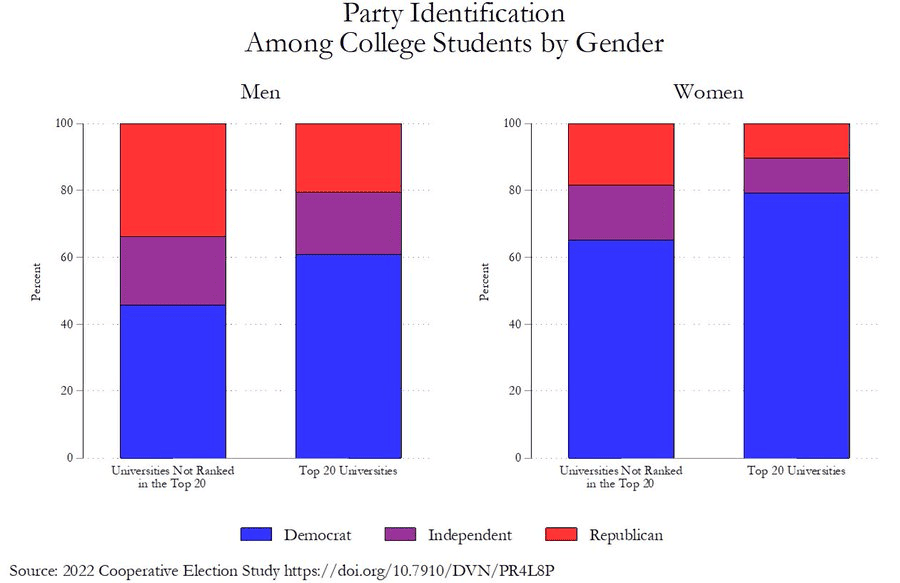
As of recent, Universities provide a clear example. Voter registration data from twenty twenty-two showed Harvard faculty at ninety-nine percent Democrat among those registered with a party. Princeton reached ninety-eight percent. Yale and Berkeley hit ninety-seven percent. Recent surveys from twenty twenty-five and twenty twenty-six confirm the pattern. Liberals dominate key fields, often seventy to eighty percent. Conservatives fall below twenty percent. Here is a chart that illustrates the imbalance:

Another view, broken down by field, shows the skew even more plainly. The ‘captured left’—once the broader Democratic Party—has filled these roles. Not every Democrat supports this. Many traditional ones feel left behind, just as I did.

How does it happen? The funnel. DEI is one of the recent tools they used. In fact, DEI statements now appear in twenty-two percent of faculty job ads. Analyses from the Manhattan Institute in twenty twenty-five found that evaluators score higher when applicants discuss race, gender, or equity in progressive terms. When applicants mention welcoming opposing political views—like true viewpoint diversity—scores drop sharply. Before DEI became common, tactics were subtler. Elite graduate schools acted as echo chambers. Networking happened in left-leaning circles. “Cultural fit” interviews quietly filtered out differences. The same pipelines feed tech, Hollywood, industry, and government.

In tech, employee donations still flow ninety-plus percent to Democrats at major firms. Hollywood funding favors Democrats by thirty-to-one in recent cycles. Government agencies—like Education or the EPA—lean left by wide margins. They draw from these same radical networks. And congressional staffers? That layer worries me most. Staffers draft bills. They gatekeep access. They whisper advice. If someone holds opposing views but pretends to align, they gain entry. They can spy. They can slow-walk. They can subvert. The setup invites it: low oversight, high influence. If control were the goal, planting them would make perfect sense. My gut hasn’t been wrong yet, so those with staffers might want to pay attention to that one.

Here is a simple funnel diagram—like hiring or politics: wide at the entry, narrow at the end.

Tactics vary. Older ones include unions—Hollywood guilds leaned left since the nineteen forties. Elite graduate programs served as feeders. “Fit” interviews filtered quietly. Newer ones use DEI and CRT as litmus tests—they evolved from civil rights efforts into ideological rubrics. Parallel tools include think tanks and advocacy groups. They supply “approved” talent. Layers hide the process—no grand conspiracy, just selective replacement.

The harm is real. Students face one story, no genuine debate. They are robbed of the opportunity to learn and experience critical thinking. They graduate shaped by dogma, not facts. Careers suffer. And the cycle continues: In tech, content moderation tilts left. In policy, regulations reflect one lens. In Congress, subversion erodes trust. Parties become tools to herd voters—conventions sideline independents, staffers nudge covertly. Both sides face capture. The very foundation of our Constitutional Republic weakens.

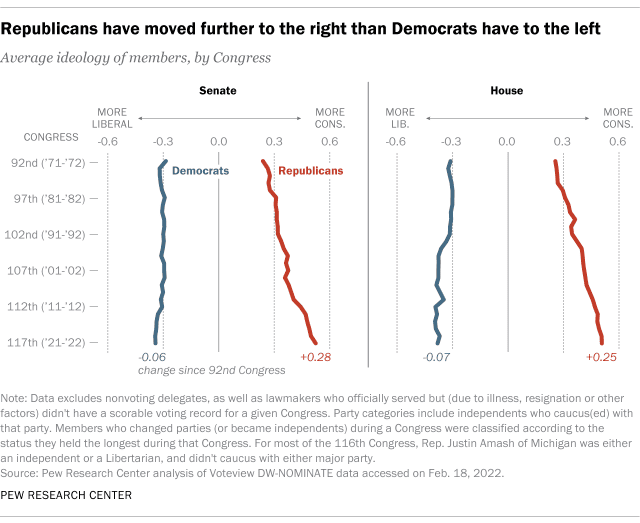
This shift shows in broader data. Polarization has grown since 2008, with Democrats pulling leftward. Here is a chart tracing that movement:

Notice: the captured left drives it—not every Democrat. Many feel alienated, as I did. The party moved; they stayed put.

What do we do? First, expose it. Publicly audit DEI statements. Track donor flows. Examine and share staffer backgrounds. Transparency ends the illusion. Second, break the funnel. Use blind hiring—no ideological oaths. Add viewpoint quotas, like race quotas but for ideas. Open pipelines—hire from everywhere. Third, demand balance. Students deserve debate. Agencies need neutrality. Elections require real choice.

This is not about attacking Democrats. It is about freeing the captured left from its own trap. Many good people remain there—traditional, fair-minded ones like I once was. They can walk away. Join America First, which should stand above parties: benefit the nation, expose capture everywhere, eradicate it. The funnel exists. The capture happens. Time to dismantle it—together. Start by talking. Share this. Ask questions. Seeing is the first step.

And then, we join together for


They Know Your Vote Before You Even Fill Out the Ballot

Are you ready to become a lot smarter? Here you go:

Imagine stepping into a polling place, checking in to vote, and in that very moment, someone else already knows how you voted. Imagine mailing in your ballot or dropping it in a drop-box, and someone else already knows how you voted. Not because they guessed. This is not science fiction. Very smart bad actors created a system that enables this, right under your noses. And you bought it under the guise of ‘convenience’. This is the core of modern election manipulation: I’ve named it ‘feedback loop predictive modeling’. It operates like a living algorithm—collecting data, refining predictions, and adjusting outcomes—all while staying completely hidden from audits, observers, and even many of the top experts.

Most people fighting for election integrity focus on glaringly obvious problems: broken machines, hacked software, or suspicious ballots. Those are real issues, but they are only the surface scratches. The real danger lies deeper, in a sophisticated, multi-layered process that bad actors—highly intelligent, well-resourced, and patient—have engineered over decades. And THIS is what they don’t want anyone to know. They no longer need to tamper with ballots at midnight. They can manipulate the game before it starts, using data we willingly give away every day without our knowledge. And because this method works up front, it evades every post-election check. That is why leaders—politicians, officials, activists—must seek out and listen to the rare voices who understand the full threat model. There are not many. In fact, I think there may only be a couple of us who see it this clearly. We must be realistic: Partial fixes from good intentions will never close the gap. We need the whole picture.

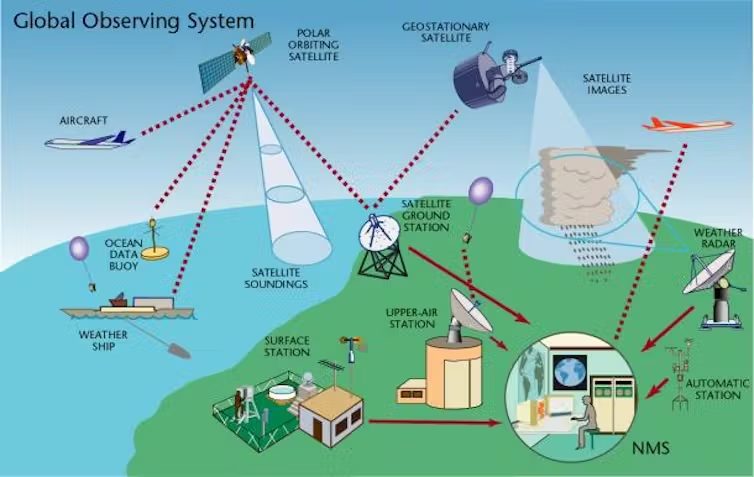
Let us start with something familiar: weather forecasting. Everyone understands how it evolved. Back in the old days, people relied on simple patterns—winters get colder, summers warmer, days shorten in fall. That was seasonal modeling: basic, reliable, but limited. Then technology arrived. Satellites circled the Earth, radars swept storms, weather balloons measured pressure, and sensors dotted every coastline. All that data—temperature, wind speed, humidity—flowed into powerful computers running complex numerical models. The result? A 5-day forecast today is more accurate than a one-day forecast was in the 1980s. A 3-day outlook hits 97% reliability. Even 7 days out, predictions hold at around 80%. Why? Because we layered real-time inputs onto historical patterns. The models learned, adapted, and got frighteningly precise.

Here is a visual of how that data flows—like satellites and radars feeding a central brain:

Election modeling follows the exact same logic—except it is invisible, and the stakes are our Republic itself.

Bad actors begin with Phase One: baseline predictive modeling. They pull from decades of records: turnout rates by county, party registration, historical swings. In a polarized country, party affiliation alone tells you a lot. Democrats vote Democrat. Republicans vote Republican. Down-ballot races follow suit—especially on divisive issues like guns, abortion, or taxes. A simple model based on party? Already decent. But they add confidence metrics: the presidential vote might score 95% certainty. A local bond issue? Maybe 70% if it is murky. This is old-school profiling—voter files, registration lists, past election data. It’s a solid foundation, like knowing that seasons change.

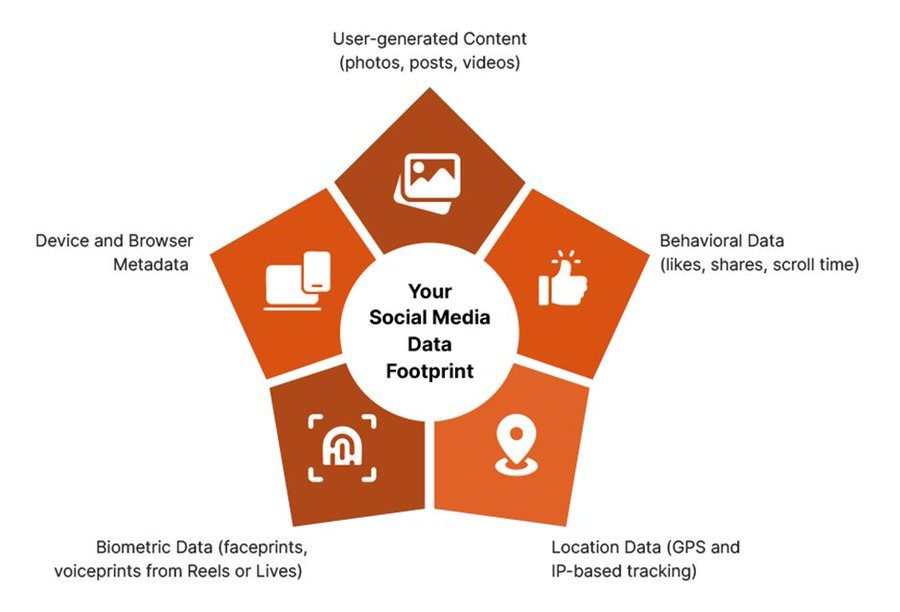
Next, and much deeper, comes voter profiling—the real sensors and radars of elections. Big data is a trillion-dollar industry because we hand over our lives in fine print. Every app, every card swipe, every search logs something. GPS tracks where you go: church on Sunday, gym at six, coffee shop downtown. Credit cards reveal purchases—books, guns, organic food. Amazon knows your tastes. Social media? Public posts show your stance on every ballot issue—climate, immigration, schools. Even private messages, if accessed, paint a fuller picture. Firms like Cambridge Analytica in 2016 scraped millions of Facebook profiles to map psychographics: fears, values, triggers. They called it microtargeting. It was voter dissection. Combine that with party? Your predicted ballot sharpens: “This independent hates regulation—92% for tax cuts.” Accuracy climbs into the high 90’s, just like a 10-day weather forecast. One person, one profile, every choice scored with eerie precision.

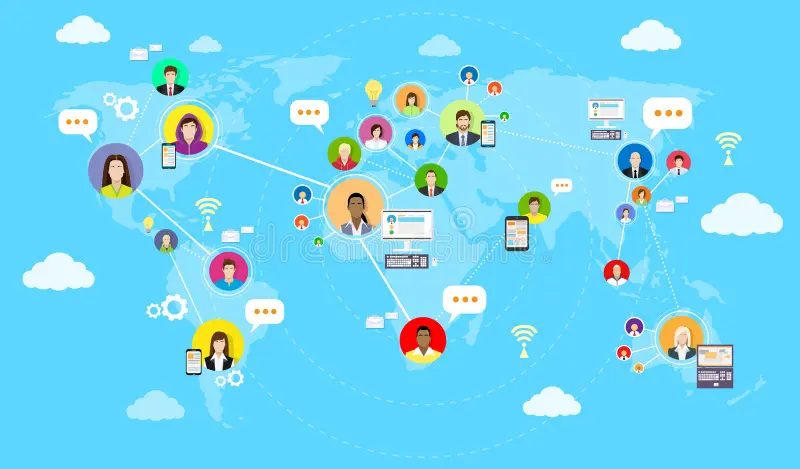
See how all that data layers around you—like a web of connections tracking every move:

And another view—your digital footprint broken down into pieces big tech harvests:

That is Phase One: baseline plus profiling equals a near-perfect ghost ballot. No votes cast. Just data shadows.

Phase Two: Voter Snapshot Modeling. Voting begins. They do not need your actual choices—just confirmation you voted. Mail-in ballots? Tracking systems sold to you on the premise of notification when yours is printed, mailed, returned, accepted—real-time, precinct-linked. But that tracking is not for you. It’s for ‘them’. In-person? Electronic poll books—tablets at the door—log you instantly. Scan your ID, and turnout ticks up. Tie that to your profile: “Early mailer from this zip code—blue-leaning, high confidence.” The model updates: “60% blue so far.” Early voting drags this out—days of live previews. The feedback loop starts: predict, observe, refine. Like weather sensors feeding storm data as it builds.

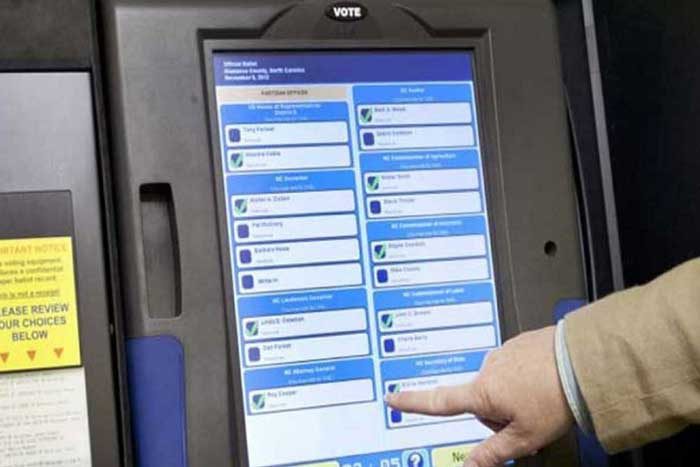
Phase Three: Vote Leak Tuning. Machines turn guesses into facts. Direct Recording Electronic (DRE) terminals? You touch the screen—choices hit digital memory immediately, by vendor design. No subtlety; data broadcasts live. Ballot Marking Devices (BMDs)? They print paper, but the touchscreen knows every selection before ink touches. Software can log it covertly—buffered, uploaded, tied to precinct and ballot style. Voters believe “paper keeps it secret.” Wrong. The computer has already tallied. Early tabulation? Lol, they’ve GOT IT ALL. The model tunes: “This candidate is down, need more injected votes. This measure is down, need more injected votes.” Confidence peaks. Subtract real from desired: exact number of fakes required.

Here is what a DRE touchscreen looks like—your vote going straight digital:

And despite a BMD (Ballot Marking Device) that most DRE’s have been swapped out for, where you touch first, it prints a ballot, and we’re told that the ballot isn’t tabulated until later, what most people don’t realize is that the machine already knows the choices. Clever, aren’t they?

Phase Four: Injection and Cleanup. With a tuned target, they act—mules drop ballots in boxes, late mail-ins arrive, extras scatter across counties.

And since nobody at the county has any way of knowing who filled out a received mailed-ballot (or drop-box ballot), they have no way of actually verifying eligibility of the voter. How do you verify eligibility of a voter when you don’t have any way of knowing who the voter is? That’s the beauty of the rig they’ve built. They’re wicked-smart.

The final tally? Matches the prediction perfectly. Audits see clean numbers because the loop engineered them. Manipulation happens upfront—data feeds, profiles, leaks—all before counting. Officials notice nothing. They’ve then got most experts chasing glitches, not the system. That’s by design.

This is why audits fail. The fraud is front-loaded. No mismatched ballots. No suspicious patterns. Just engineered outcomes. That is the sophistication most miss—and why we cannot rely on surface fixes.

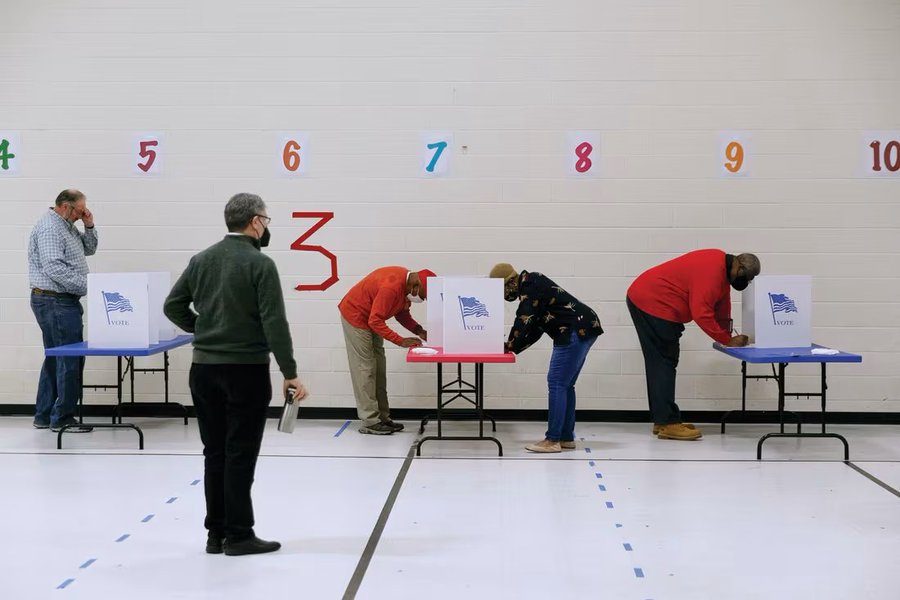
The solution is brutal simplicity: eliminate the preview. One-day voting only—at your precinct, on Election Day, with hand-marked paper ballots. No early voting. No late arrivals. Count them right there—bi-partisan teams, video-recorded, batches of twenty-five, witnesses watching every mark. Use translucent boxes, locked chains of custody. Electronics? A dumb scanner and simple inexpensive cameras only after polls close—for video and PDF images and records only, never for deciding winners. The key is NO ballots accepted post-close.

And observers right there—people you can see, not predictive feedback-loop-based algorithms you cannot:

That process exists. I built it. Watch how real, visible counting looks—no machines, no secrets, fully transparent at https://a-count-able.org: batch randomization, public tallies, full transparency.

And the complete ecosystem? Paper registration every two years, fourteen-hour national window, precincts capped at 1500 voters, even unlimited open public audits from ballot images and video footage. It is all at https://HandCountRoadShow.org/solution. Read it. No data pipelines. No leaks. No loops. Just human eyes on paper, in public, before a ballot even leaves the room.

I even co-authored a proposed executive order to address this current ELECTIONS NATIONAL STATE OF EMERGENCY: https://HandCountRoadShow.org/eo.

We do not need smarter machines. We need no secrets. Listen to the voices who understand the full depth—not only the fragments. And what do we do right now with only months left? Vote ON ELECTION DAY and IN-PERSON to deprive bad actors of their feedback loop. And vote in massive numbers, like your ballot matters, Because when we do, it finally will.


Virginia joined the National Popular Vote Compact — A direct attack on fair elections.

Signature: SqJDS4PG6h6lUZtNhDeqSQL/COgt2eE26XxjTRoIP8AJiANE3doQkXAS6rleJRNkaHQ0Eb86EZtUoHfnnkr8W6lA/u0p5mClqNcWnYH6MXYxhqeCuf0N8Snyvwd6SE5NEQHd/8FD0YH3DNMwj1X4Xp4SIF+Xz0Ms1ByuNVZchkNbbZ2nOFbqXWPpy6oyb4ZimQg82g1UsvT62rhslW3mWX/CfrHxlNCm8lirsLu7I9fwpAo5ShGZOIzrWKca77rKBFCywdtfyEUCD5Kv+XSOQ5VEn71Txu1PwKe/hr4UgVqBiwR2DINbmSeLw7jUCPClsHCGw3FrAOwaGYaFpCYBbyYn9hSPL1qFaPjfy/PzyDmOrjF6FEaUcxXCu0iRzU6aHnIb9fJMHy+XzTTTBOB5pe1llJdrpthnG/SOfpU/U27H0CUiNafijQwV576r4fQGL4vROs3FXR5HFVf/rydG5VDwwEKOzLqvyy5kDsT6bvPNb1ahw2BSXgpJg5QggnnSaM6jW8bl90pyf9IOZyrR3NGac1RewrorE4l/L/BnDOaA4epra15NvVI+UCwiTjGhGOds+s799OqQ8lwvEkiKNReLBzZRR65QKRoh/rmXIN28WFCKDvwduFYe2ZG9+Uo1s99bF7jC2H4ZLabtF7iPdadiliJHQ1cJwgbQpugW3/GRyQurFk9DpQYGhQmhs7sfeOOx3OEwy6zPDxBTxgxiMCnX6iaC9xMf9zNGXuZEJcXUyr7f42aKcBGBO3zrR6vNefeO5lUOrBsk8ULgwrHdcG8BzIcav7gwtM0WSIrzZh1hRAbGj9h2wnRQ7x0pe/Js+eu7GcyQ0W7DGfL3h8B4sEZHB653eU4JoG0lsS7spJX/ERIJMSzgc0RVHSEn09isZBce8jkjvw+2eAP4Hqle9C40zFUGRtpEzpHHfaKvlLP8av4Rh0U0YQBlEaLD32HqrBRg16TbyK7cbFPCTMKxjFi9GdUQceJvblK6ViLNdLQ=

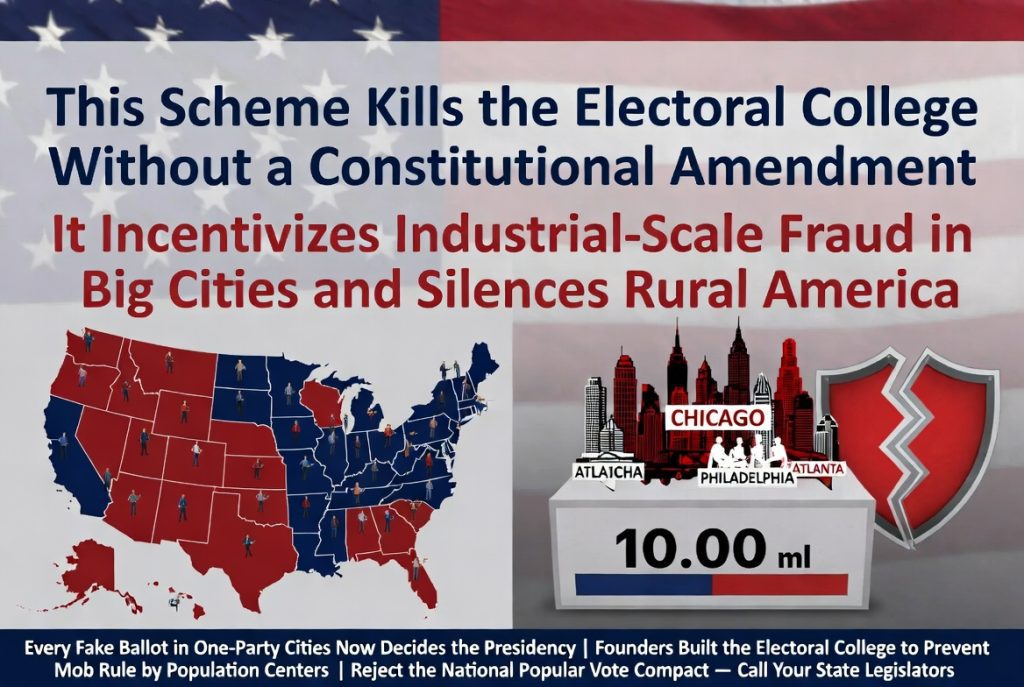
This scheme kills the Electoral College without a Constitutional amendment. Once enough states sign on, your state’s votes go to whoever wins the national popular vote — no matter how your own state voted.

Here is why this is catastrophic:

Every single ballot in America suddenly matters equally in one giant national count. That sounds fair until you realize where massive, organized fraud actually happens — in the big, one-party-controlled cities. Chicago, Philadelphia, Atlanta, Detroit. These are exactly the places where thousands of ballots can be manufactured or flipped in the dead of night with almost no real oversight.

Right now, under the Electoral College, stealing 50,000 votes in a deep-blue city that already goes 80-20 for one side changes nothing. The state is already locked. Under the National Popular Vote, those same 50,000 fake votes move the national total by 50,000. Suddenly the payoff is enormous and the incentive to commit industrial-scale fraud goes through the roof.

This turns every urban political machine into a national kingmaker. Rural America, small towns, and red states get completely silenced. Your vote in flyover country becomes worthless compared to the machines in the big cities.

The Founders built the Electoral College for one reason: to stop pure mob rule by big population centers and to force candidates to care about the entire country. This compact destroys that protection.

This is not reform. This is rigging the game at the national level. And it is happening right now, and it’s coming to YOUR STATE if it hasn’t already made it there.

Share this before it is too late. Call your legislators in every state. Demand they reject this dangerous compact. It will be the end of the Republic.

MAKE SURE EVERYONE IS AWARE OF THIS.


Burden Inversion: Has Everyone Lost Their Damn Minds?

Signature: 8PnMUVj3BvzEDYNrIvG2ys28ORPav80lRSB6plVUGddO1Dg/D+Rktxkt0Y0jfA9T+JGmNJINZn3Dtq4/00Tk95AF+5QOjN9i9Iwi1sDmgS9CVJePFXp+S676Sb/AJJr/naGwaeuYGFT5bJQLe+gkMKTSMRw6nKE+ZPYOiNbhTR+vU0uEiRMLXZ5x93N+9GJW3b/9Io7+GXLnS5LwHy2G+NhFKulieuCbG5/PRoL6x1U750ng5cGeXNue6upc/iKELVKRch9VWGit6IebHsl1g5KQXyo2OP5zJAYtN5s+1Rc7qK7+mOd7Uhtit98MELBgiW4cdAF/2UHeFPnqCNnrodhTG5Pw2GE38PB8RMV35YwCZKT9QILhZHGmEPzk3WugkZ/Mqjqhff+zLbsjSDJKGHU+fcAuZ52oButbWwdZl+o1zjILK5e0ybb7iQa5OEBD3IdVuPKpxQnImseRxm1oOigAEkd+1L94qaSKI53MGO2ET6a7K20PShdgtP6SOiyjSilGiiSgCZd+KnI8l99bQlx/5TAGLhJJH4JEAhsfr1zbWKboxV8jVnEzMV8iIY+GOGL0IJP9JincR79UPm1EcAnFtQxjqjVYznyM07lrTpKEGSHtiQZWYXap68RI+RD59MtZPotE5W+gjrwI0wjoSGS/i1XWiSOjA7DimEnaSyyvU0iSogRBYv4Xhvwn+tYaVALiQmXJB8eLkfQPoDWtt4gCl7RGbuEnn04PIr87LLdiShDFDv5L+d1qkJXbM9ZmUs0IAaUQrMTD0LLbm8h9yuL+KziheQKTWYRFpC/RJq3GWjkc4f+xlJdlCUS1PDwOan7MCfHzOKr3vKxhWqNRUtVIWa4hBPybRf0ef6mey5B1shpOyTZUGfJl/qcFq3w0uNpFXRnDMBo3t/0hCPk0pXq2FtpMtfxDwaoFBuV5WgCsVbgaY1bprD/4TefjNY+otYAeKt1R0kGfbgMzIH2fGcramrTnmHcddg4bMuFKvHc=

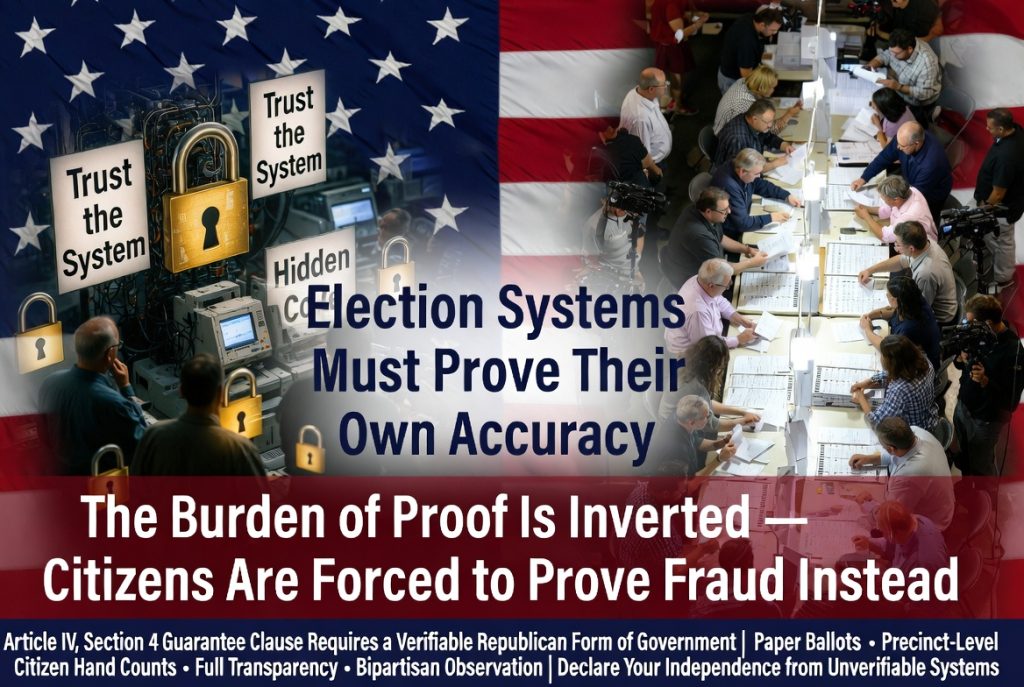
Our election systems do not produce results that can be independently verified as accurate. That single fact should alarm every American, yet instead of fixing the systems, we are told we must trust them. The burden of proof has been completely inverted. Citizens are expected to prove fraud after the results are announced, while the systems themselves face no requirement to prove they got it right. This is not a reasonable standard. It is madness.

A legitimate election system must do one thing above all else: produce results that can be transparently and independently confirmed to reflect only the will of eligible voters. This is not an opinion. It is a constitutional requirement.

Article IV, Section 4 of the United States Constitution

, the Guarantee Clause, commands that every state shall have a republican form of government. That form of government rests on the genuine consent of the governed. When the counting process is opaque and unverifiable, that consent cannot be confirmed. The system therefore fails the Constitution’s most basic test.

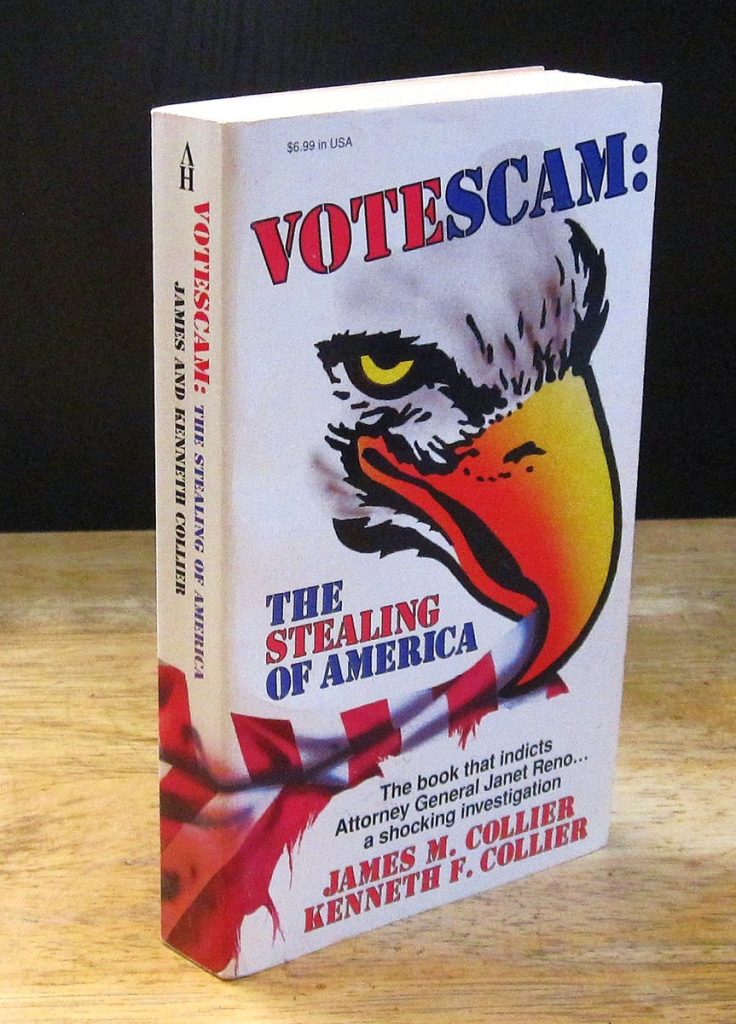
This inversion did not begin in 2020. It did not begin with any single candidate or party. For generations, both Democrats and Republicans have seen elections overturned because of proven fraud. Congress has thrown out results in contested House races on both sides of the aisle. The pattern is old, and the victims have come from both parties. James and Kenneth Collier documented this reality decades ago in their book Votescam.

They exposed how early computerized voting systems created hidden opportunities for manipulation while removing the vote count from public view.

None of this happened by accident. Sophisticated actors deliberately channeled the public into an impossible task. Year after year, the same phrases were repeated with mechanical precision: “baseless claims,” “no evidence,” and “where’s the proof?” These words did not invite scrutiny of the systems. They forced citizens to chase an evidentiary burden that was designed to be unmeetable. Had the question been “Can this system prove its own results are accurate?” instead of “Can you prove fraud?” the entire debate would have collapsed within the first year.

The most obvious warning sign is the relentless demand that we simply trust the system. Institutions invest massive energy telling the public (including our own Election Officials) to have faith in the process. A system that truly works does not need to beg for trust. It earns trust by being transparent and verifiable. When perceived authorities must constantly demand belief rather than demonstrate proof, they are admitting the system cannot stand on its own.

Consider how sophisticated criminals operate. Modern car thieves do not pick locks with paper clips. They use electronic scanners to clone key fobs from a distance and sophisticated devices to bypass computer systems once inside the vehicle. The more complex the car’s technology, the easier it is for experts to defeat it while the average owner remains unaware. Our election systems have been built with that same dangerous complexity. They produce results that look official to citizens and election workers alike, yet those results cannot be independently verified by the people whose government is being chosen. If intelligent actors wanted to manipulate elections while maintaining the appearance of legitimacy, this is precisely the system they would design.

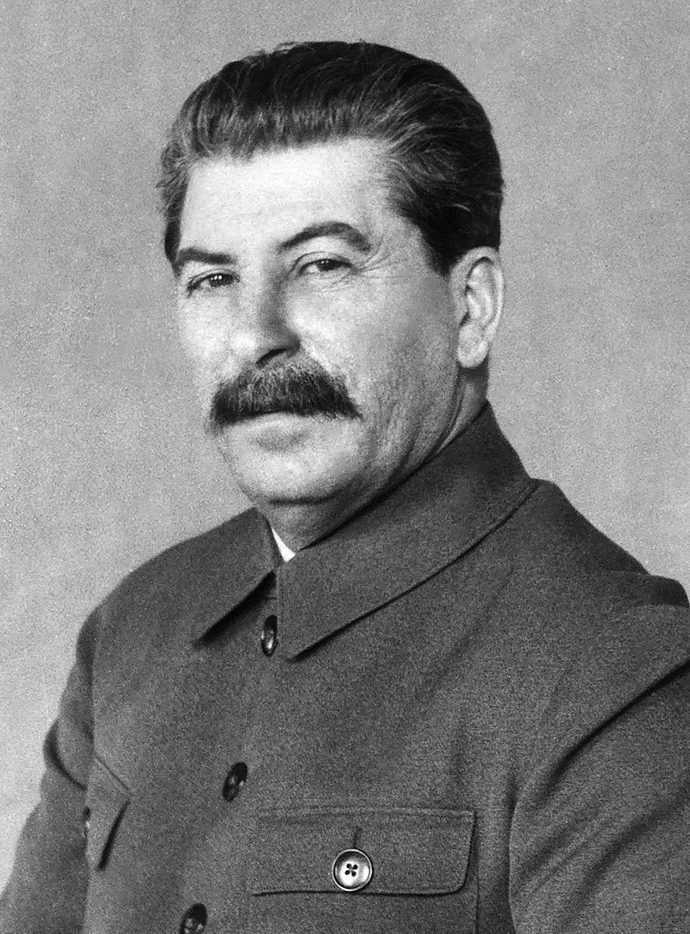
Joseph Stalin stated in 1923, “I consider it completely unimportant who in the party will vote, or how; but what is extraordinarily important is this—who will count the votes, and how.”

What would very intelligent, sophisticated, and evil people do if they wanted to take over a nation without firing a single shot? They would remove the people from the counting process. They would replace transparent paper ballots and public observation with complex electronic systems that only a handful of ‘experts’ truly understand. They would meticulously train the public to accept results on faith alone. It might even jail or imprison those that attempt to question it, like they have done with Tina Peters.

They would make any challenge to the system seem unreasonable or even dangerous. They would invert the burden of proof so completely that the people would spend years trying to prove fraud instead of demanding that the system prove its own accuracy.

That is not a conspiracy theory. That is a precise description of the system we have been living under.

The solution is not more accusations. The solution is to build systems that no longer require blind trust because their accuracy can be seen and confirmed by any citizen who cares to look. Secure, in-person paper-based voter registration managed only by our local county servants, Citizen-run precinct-level hand counts on election day, under bipartisan citizen observation, with immediate public posting of results. Strict limits on absentee ballots. Full transparency of every ballot image, video footage of the vote counting process, and chain-of-custody records. These are not radical ideas. They are the minimum requirements for a system that can actually prove it got the answer right every time.

Until we restore the correct burden, until the system itself must prove its accuracy, the Guarantee Clause remains unfulfilled. A republic that cannot verify its own elections is not a republic at all. It is simply an illusion of a republic.

The question is no longer — and never should have been — whether fraud occurred in any particular election. The question is whether we have all lost our damn minds by accepting systems that can never prove they are honest. The answer, unfortunately, appears to be yes.

So, are you ready to Declare Your Independence?


The Evil Genius: How America Really Lost Control of Its Elections

For years, audiences have asked me “but WHO is THEY???”. So I decided to give them a picture to help them understand — the sinister figure — cold, calculating, holding the entire world in his hands while peering at it through an eyepiece. That image represents what I call the “evil genius.”

An evil genius is not a crazy person or a low-level criminal. He is someone who possesses two dangerous traits at the same time: exceptional intelligence and complete absence of morality.

There is more than one, yes. These people understand the critical importance of something most Americans have sadly, now forgotten: Our country was deliberately designed as a decentralized republic. Power was meant to stay in the hands of the people, not the government. That’s why our election system was also built to be decentralized. From the beginning, it was never government officials or private companies who counted the votes — it was the citizens themselves, counting their ballots in public at the local precinct level.

This was not an accident. A decentralized government requires a decentralized election system to survive. If you centralize components of the elections, you will eventually centralize the government itself.

The evil geniuses understood this perfectly. They knew that controlling a few centralized points was far easier than trying to control thousands of independent precincts. So over decades, they slowly centralized our elections under the cover of “progress,” “efficiency,” and “modernization.”

They didn’t do this work themselves. They used millions of good but ignorant people — including election officials — to help them. Officials were told that voting machines and centralized counting would make their jobs easier and reduce fraud. Instead, we traded a simple, transparent, decentralized system where fraud was visible for a complex, centralized system where fraud could be hidden at massive scale.

This was their true genius: They didn’t need to commit obvious crimes. They simply changed the structure of the system so the truth became nearly impossible to see — while keeping the outward appearance of democracy intact.

Most Americans still believe they are voting in real elections. That illusion is the most brilliant part of the strategy.

The good news is this does not have to continue.

The solution is not complicated. We must return to the fundamentals our Founders understood: hand-marked paper ballots, counted openly by citizens at the precinct level on election night, with the entire process recorded. Modern technology now makes this easier and more transparent than ever before.

In fact, the Progressive Election Platform lays out specifically all that is needed to instantly restore our Republic:

The PEP

We do not need to ask permission. The people who currently run the system work for us, not the other way around. When enough Americans decide they will once again count their own votes, the evil geniuses will lose their power — and the republic can be restored.

Like some others have done, I encourage you to print out the following Declaration, and kindly hand-deliver a copy of it to every public official you know.

The Declaration


How Election Officials Were Conned by Risk-Limiting Audits — And the Easy Solution

Executive Summary

Risk-limiting audits (RLAs), developed by statistician Philip B. Stark, offer a statistical method to check election results—but only when applied to a complete, intact, and trustworthy voter-verifiable paper trail. All post-election audits, including traditional fixed-percentage checks, share a critical limitation: they cannot create trustworthiness where none exists.

When election officials claim that any audit proves accurate results, they produce a false sense of security. This illusion misleads citizens, sustains insecure voting systems, and creates opportunities for undetected manipulation. Even after the inventor of RLAs publicly exposed this misuse as creating a false sense of security for unverifiable systems, election officials continue to rely on and promote these audits, passing the misleading assurances to the public and dismissing citizen concerns.

The only reliable path to verifiable election accuracy is direct hand-counting of paper ballots by citizens at the precinct level on election night, with full transparency and public oversight. Audits alone are insufficient and can serve as a pathway for bad actors to introduce or hide errors while evading detection.

Philip B. Stark and the Origin of Risk-Limiting Audits

Philip B. Stark is a Distinguished Professor of Statistics at the University of California, Berkeley, specializing in uncertainty quantification and election auditing. In 2007–2008, as part of California’s Post-Election Audit Standards Working Group, he developed risk-limiting audits (RLAs). Key publications include “Conservative Statistical Post-Election Audits” (2008) and “A Gentle Introduction to Risk-Limiting Audits” (with Mark Lindeman, 2012). Stark also produced open-source tools for sampling and risk calculation and advised on implementations such as Colorado’s first statewide RLA in 2017.

Precise Mechanics of Risk-Limiting Audits

An RLA is a statistical procedure that manually examines randomly sampled ballots from a trustworthy paper trail. It limits the probability of certifying an incorrect outcome to a pre-specified risk limit (for example, 5%). If discrepancies suggest the reported result may be wrong, the audit expands until the risk limit is met or a full hand count corrects the outcome.

RLAs require strict prerequisites: a complete voter-verifiable paper trail (preferably hand-marked ballots), a compliance audit confirming chain of custody and ballot accounting, a ballot manifest, and verifiable random sampling. Two approaches exist—ballot-polling (hand review without machine records) and ballot-comparison (matching hand counts to machine records). Sampling increases as needed. These features make RLAs statistically stronger than traditional audits, but they provide zero assurance without trustworthy underlying records.

Stark’s Resignation from Verified Voting

On November 21, 2019, Philip B. Stark resigned from the Verified Voting board. The full text of his resignation letter follows:

21 November 2019
Dear colleagues–

With sadness and disappointment, I am resigning from the board of Verified Voting.

I believe that Verified Voting has lost its way.

It has been providing cover for inherently untrustworthy voting systems–and the officials who bought them, the companies that make them, and any officials who might contemplate buying them in the future–by conducting “risk-limiting audits” of untrustworthy paper records, creating the false and misleading impression that relying on untrustworthy paper for a RLA can confirm election outcomes (and debasing the meaning of “RLA” in the process).

This contradicts the most basic principle of Evidence-Based Elections: the need to establish that the paper trail is trustworthy.

Several months ago, I asked VV to revise its published policy on BMDs to clarify that parallel testing cannot show that BMD printout is trustworthy. The current policy on parallel testing of BMDs is counter to the advice of David Jefferson, Ron Rivest, Andrew Appel, Rich DeMillo, and me (and perhaps other board and AB members). I have repeated the request. Yet, months later, the original document stands.

VV is promoting the “shiny” part of auditing–the RLA procedure–at the expense of a far more fundamental requirement for trustworthy elections: a trustworthy paper trail. Whitewashing inherently untrustworthy elections by overclaiming what applying RLA procedures to an untrustworthy paper trail can accomplish sets back election integrity. This is security theater, not election integrity.

Indeed, VV publicly claimed that the pilot RLA in Georgia confirms the election outcomes, despite the fact that it was conducted primarily on universal-use BMDs with serious usability and security defects. I understand that the press quotation from Marian about the audit was not approved in advance by her, but she has clarified by email that she believes it is true.

I do not.

That statement has done damage to a case trying to hold Georgia SoS accountable for historical neglect of election integrity and its ill-advised decision to buy universal-use BMDs, a case in which I have submitted several reports, and which involves Rich DeMillo more centrally. I predict it will also become part of the vendor’s advertising for universal-use BMDs. It amounts to a product endorsement from VV that their systems can be proved to get the correct outcome by the “gold standard,” a RLA.

I asked VV to issue a public clarification (press release or policy statement) that RLAs cannot show that BMD output is trustworthy–nor can any other audit establish that BMD printout is trustworthy–and that basing an audit on BMD output cannot confirm election outcomes. I asked a week ago, to allow time for the statement to be used in court filings to counter claims that Georgia election officials have made in court documents, quoting VV’s participation in the “audit.” No such statement has been made.

I also tried to prevent VV from making a similarly misleading claim about auditing in Philadelphia–but it did: Today, VV is conducting a “RLA” relying on the Philadelphia ExpressVote XL printout, and claimed on Twitter that it will “confirm election outcomes.” That is patently false. But I’m sure it will be in ES&S press releases and promotional materials within a few days.

VV should be making it clear that trustworthy paper is prerequisite to conducting a RLA, and that auditing the tabulation provides no evidence that outcomes are correct if the paper trail is not trustworthy. Applying RLA procedures to BMD output might show that tabulation errors are not large enough to produce the apparent margin, but it can’t confirm election outcomes, because there is no trustworthy touchstone. Evidence is what matters, not mindlessly applying a procedure. RLAs are not magic. They do not cure all the ills of any system that produces some kind of paper “backup.”

Indeed, the need for evidence that the paper trail is trustworthy applies to hand-marked paper ballots as well as to BMD printout: VV should be demanding convincing evidence that the paper trail is trustworthy, and helping jurisdictions develop laws, regulations, and procedures to make it possible to generate that evidence. That requires a compliance audit that checks the chain of custody of the paper, ballot accounting, eligibility determinations, signature verification, among many other things. A compliance audit of a universal-use BMD system cannot provide affirmative evidence that the paper trail is trustworthy. No procedure can. (“Trustworthy” means that a full hand count of the paper would show who really won. It does not mean that every last vote was captured and retained accurately.)

Verified Voting is providing cover for bad actors (election officials and vendors) and inherently untrustworthy voting systems (poorly designed, inaccessible universal-use BMDs) by conducting “risk-limiting audits” of paper trails that cannot in principle be established to be trustworthy even if there were good laws and regulations for compliance audits. VV is helping election officials who purchased poorly designed, unnecessarily expensive, insecure, universal-use BMD systems justify their purchases–despite the fact that virtually every expert on our board and advisory board recommended against purchasing universal-use BMDs. The election officials are now touting the fact that VV helped them conduct (i.e., pilot) RLAs to brag that their systems are trustworthy after all–and to claim in court that the audits prove their systems are trustworthy. VV is giving vendors quotes, talking points, and–in effect–product endorsements for insecure, inaccessible systems. VV is on the wrong side.

Our message to jurisdictions that buy poorly designed, insecure, universal-use BMD systems should be, “We tried to warn you. You need a better voting system.” Instead, we’re saying, “Don’t worry: VV will teach you to sprinkle magic RLA dust and fantasies about parallel testing on your untrustworthy election. All will be fine; you can use our authority and reputation to silence your critics.”

For well over a year, VV has been doing things that contradict and undermine my research, my publications, my expert reports, and my public testimony. Whatever good VV might be doing on other fronts, I cannot continue to support the organization.

I hope you will consider resigning, too.

Regards,
Philip

Misuse of RLAs and Traditional Post-Election Audits

As of 2026, seven states require RLAs by law, with about fifteen authorizing or piloting them. All fifty states perform some post-election audit. Traditional fixed-percentage audits review a set portion of ballots or precincts (often 1–5%) without statistical guarantees or required escalation.

Both RLAs and traditional audits fail when the paper trail is untrustworthy—such as records from universal ballot-marking devices. Real-world examples include pilots in Georgia (2020) and Philadelphia, where claims of “confirmed” outcomes were made despite fundamental weaknesses. Traditional audits are even less effective due to weaker sampling and no mandated full recount. In all cases, audits check only a subset of records. This limited scope allows bad actors to manipulate results in ways that avoid detection in the sampled portion.

The Core Vulnerability – Untrustworthy Audit Trails

A trustworthy paper trail directly captures voter intent and maintains unbroken chain of custody. Audits examine only samples and cannot retroactively establish integrity. Claiming that an audit proves accuracy without this foundation is security theater. It creates the dangerous belief that “checking some of the garbage” suffices. Throwing ballots into complex systems and auditing a fraction of them is an absurd method for verifying the people’s will. Bad actors can exploit this by concentrating manipulation outside the audited sample, knowing the process will likely pass.

National Implications of False Assurance

Election officials’ routine claims that audits demonstrate accurate results represent a critical and dangerous error. These statements foster public complacency while sustaining systems vulnerable to undetected error or fraud. Elections are the highest-value targets in our Republic. False assurance from audits breeds opportunities for manipulation at scale. Bad actors can alter outcomes without triggering full recounts, undermining governance, policy, and the rule of law.

The critical mistake is not merely technical. Officials, having been given false assurances about the power of audits, sincerely believe and transmit those assurances. Citizens receive and accept them. The result is a closed loop of deception that shields unverifiable systems from scrutiny and chastises those who question them.”

The only legitimate way for American citizens to trust election results is direct hand-counting of paper ballots by citizens themselves at the precinct level on election night. This approach eliminates reliance on machines, limits absentee ballots to verified necessities, uses small precincts (≤1,500 voters), requires bipartisan citizen counting under video recording, and makes all images, tallies, and records publicly available for immediate verification. Results are posted locally the same night. Public audits by citizens and students provide ongoing checks. This method replaces blind trust in partial audits with verified accuracy through transparent, observable counting where cast. Audits cannot substitute for this foundational process. Continued dependence on them invites exploitation and erodes our Republic.

Conclusion

Risk-limiting audits improve statistical rigor over traditional audits only when applied to trustworthy hand-marked paper trails. However, all audits share the same fatal flaw: they provide no affirmative evidence without verified records and can mask manipulation.

The continued reliance on audits—despite the inventor’s public condemnation—demonstrates that the false claims persist. This is the whistle that must be blown: audits cannot and do not provide the verified accuracy citizens require.

The solution is clear: return to simple, transparent, precinct-based hand counting by the people themselves, with full public access to records. Only verified accuracy—through direct observation and counting—restores legitimate trust in election results. Without this shift, the illusion of assurance will sever the final thread of our Constitutional Republic.


The Same Company Certifies America’s Voting Machines & the Lottery Systems That Got Rigged for $24M

One lab. Two systems that control power and wealth. And a documented, massive failure that should terrify every voter in America.

🚨 This is the connection that should stop every American cold.

SLI Compliance — a division of Gaming Laboratories International (GLI) — is one of only two federally accredited labs in the United States authorized to test and certify electronic voting systems used in elections nationwide. (The other is PRO V&V).

They perform the exact same rigorous testing on both voting machines and lottery/gaming systems:

  • Source code review
  • Security and vulnerability analysis
  • Functional testing
  • Official certification

GLI/SLI has certified systems from Dominion, ES&S, Hart InterCivic, and others deployed across dozens of states.

The same company also certifies the random number generators, draw software, and security systems for state lotteries and the global gambling industry.

The Scandal That Proves the Danger

Between 2005 and 2017, the largest lottery fraud in U.S. history unfolded: the Hot Lotto Scandal.

Eddie Tipton — Director of Information Security for the Multi-State Lottery Association — inserted just two lines of malicious code into the random number generator software.

That software had already been tested and certified by GLI.

Tipton deliberately designed the backdoor to survive their standard source code reviews and testing procedures.

Result? He and his accomplices rigged jackpot drawings across multiple states and stole more than $24 million.

GLI did not catch it.

The Direct Parallel That Should Shock You

Same certifying lab. Same testing standards. Same high-stakes software environment handling random selection and tabulation.

If a sophisticated insider could completely bypass GLI’s certification process in lottery systems…

What did they miss in the voting systems they certify for our elections?

Or worse — what could a determined actor hide or enable?

Your lottery ticket and your ballot are both “protected” by the same gatekeeper.

This is not speculation. This is documented, court-proven history.

One company stands between trust and catastrophe in two of the most critical systems in America.

The integrity of our elections deserves far better scrutiny than a single lab with a proven blind spot in the exact domain it oversees.

America’s vote must not rest on the same foundation that failed its lottery systems.

We’ve demanded answers. We got none.

We’ve demanded transparency. We got none.

We’ve demanded to run our own election. We got denied.

American, it’s time to take back our elections, regardless of the obstacles.

Read the Declaration

and GET BUSY. We are not accepting ‘NO’ for an answer.


The Power of Repetitive Framing: How “Our Democracy” Redefines America’s Constitutional Republic

In recent years, I couldn’t help but notice the phrases “our democracy” and “threat to our democracy” had become more dominant in American political speech and media by the day. In contrast, references to “our republic” remained rare. You must understand that this pattern is not accidental. It represents a sustained campaign of repetitive framing designed to shift public understanding of the U.S. system of government, an effort to subvert it.

The United States is a constitutional republic. The word “democracy” does not appear in the Constitution or the Declaration of Independence. Nowhere. Not in one place. Article IV, Section 4 of the Constitution guarantees every state “a Republican Form of Government.” The Founders intentionally built safeguards against pure majority rule, including the Electoral College, equal state representation in the Senate, separation of powers, federalism, and the Bill of Rights.

James Madison warned in Federalist No. 10 that pure democracies are “spectacles of turbulence and contention” incompatible with personal security and property rights. The constitutional republic was designed to protect individual liberties from transient majorities.

Repetitive Framing Explained

Repetitive framing is the coordinated, high-frequency use of a preferred term across politicians, organizations, and media. It exploits the “illusory truth effect,” whereby repeated exposure causes people to perceive a statement as true regardless of its accuracy. By constantly repeating “our democracy,” the frame gradually replaces the precise constitutional description with one that emphasizes unlimited majority will.

Empirical Evidence

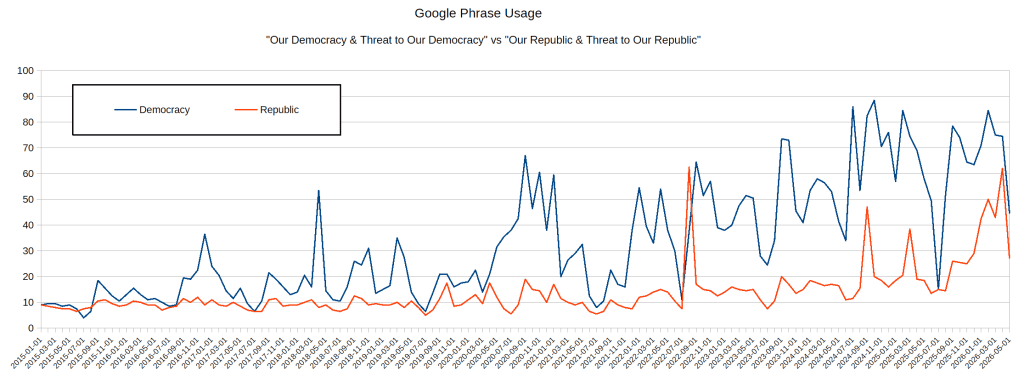
Figure 1 – Google Trends Combined Interest (Monthly Average, United States, 2015–2026) “Our Democracy” + “Threat to Our Democracy” (blue) versus “Our Republic” + “Threat to Our Republic” (red)..
*Source: Google Trends data. Combined values calculated as the monthly average of each pair.*

The data show a sharp and persistent divergence beginning in 2016. The “Democracy” line rises dramatically and remains elevated, frequently reaching scores of 60–90. The “Republic” line stays comparatively low and stable. This asymmetry reflects concentrated rhetorical effort rather than organic public usage.

Why the Distinction Matters

When the nation is consistently framed as “our democracy,” constitutional restraints—judicial review, state election authority, Senate procedures—are increasingly viewed as obstacles rather than essential protections. Policies that would weaken these republican safeguards are then presented as necessary defenses of “democracy.” This rhetorical inversion undermines public appreciation of the deliberate design chosen by the Founders.

How to Detect and Counter It

  • Observe when “democracy” is used without reference to “republic.”
  • Note when constitutional mechanisms are labeled threats to democracy.
  • Demand precise language: the United States is a constitutional republic.
  • Any time you hear or see “our democracy”, reply with this correction: “we do not have a democracy; we have a Constitutional Republic”. Consistent, widespread use of this correction helps neutralize the illusory truth effect over time.

Accurate terminology is a non-partisan civic responsibility.

Conclusion

The repetitive use of “our democracy” is a clear example of linguistic framing intended to reshape how Americans understand their government. Recognizing this technique allows citizens to see the manipulation and restore constitutional clarity.

The complete dataset is attached below for reference and verification:

date,“Our Democracy”,“Our Republic”,“Threat to Our Democracy”,“Threat to Our Republic”,Combined Democracy,Combined Republic
2015-01-31,18,18,0,0,9,9
2015-02-28,19,17,0,0,9.5,8.5
2015-03-31,19,16,0,0,9.5,8
2015-04-30,17,15,0,0,8.5,7.5
2015-05-31,18,15,0,0,9,7.5
2015-06-30,15,13,0,0,7.5,6.5
2015-07-31,8,15,0,0,4,7.5
2015-08-31,13,16,0,0,6.5,8
2015-09-30,37,21,0,0,18.5,10.5
2015-10-31,31,22,0,0,15.5,11
2015-11-30,25,19,0,0,12.5,9.5
2015-12-31,21,17,0,0,10.5,8.5
2016-01-31,26,18,0,0,13,9
2016-02-29,31,21,0,0,15.5,10.5
2016-03-31,26,20,0,0,13,10
2016-04-30,22,18,0,0,11,9
2016-05-31,23,18,0,0,11.5,9
2016-06-30,20,14,0,0,10,7
2016-07-31,17,16,0,0,8.5,8
2016-08-31,18,17,0,0,9,8.5
2016-09-30,39,23,0,0,19.5,11.5
2016-10-31,38,20,0,0,19,10
2016-11-30,45,24,0,0,22.5,12
2016-12-31,37,18,36,0,36.5,9
2017-01-31,48,22,0,0,24,11
2017-02-28,41,18,0,0,20.5,9
2017-03-31,29,17,0,0,14.5,8.5
2017-04-30,23,20,0,0,11.5,10
2017-05-31,31,17,0,0,15.5,8.5
2017-06-30,19,14,0,0,9.5,7
2017-07-31,13,13,0,0,6.5,6.5
2017-08-31,21,13,0,0,10.5,6.5
2017-09-30,43,22,0,0,21.5,11
2017-10-31,38,23,0,0,19,11.5
2017-11-30,32,17,0,0,16,8.5
2017-12-31,26,18,0,0,13,9
2018-01-31,28,18,0,0,14,9
2018-02-28,41,20,0,0,20.5,10
2018-03-31,32,22,0,0,16,11
2018-04-30,54,16,53,0,53.5,8
2018-05-31,29,18,0,0,14.5,9
2018-06-30,22,14,0,0,11,7
2018-07-31,21,13,0,0,10.5,6.5
2018-08-31,32,15,0,0,16,7.5
2018-09-30,52,25,0,0,26,12.5
2018-10-31,49,23,0,0,24.5,11.5
2018-11-30,36,18,26,0,31,9
2018-12-31,27,19,0,0,13.5,9.5
2019-01-31,30,18,0,0,15,9
2019-02-28,33,18,0,0,16.5,9
2019-03-31,31,20,39,0,35,10
2019-04-30,29,16,26,0,27.5,8
2019-05-31,28,21,0,0,14,10.5
2019-06-30,19,16,0,0,9.5,8
2019-07-31,13,10,0,0,6.5,5
2019-08-31,27,14,0,0,13.5,7
2019-09-30,42,23,0,0,21,11.5
2019-10-31,42,35,0,0,21,17.5
2019-11-30,32,17,0,0,16,8.5
2019-12-31,35,18,0,0,17.5,9
2020-01-31,36,22,0,0,18,11
2020-02-29,45,26,0,0,22.5,13
2020-03-31,28,19,0,0,14,9.5
2020-04-30,42,35,0,0,21,17.5
2020-05-31,35,24,28,0,31.5,12
2020-06-30,33,15,38,0,35.5,7.5
2020-07-31,23,11,53,0,38,5.5
2020-08-31,38,18,47,0,42.5,9
2020-09-30,98,38,36,0,67,19
2020-10-31,60,30,33,0,46.5,15
2020-11-30,69,29,52,0,60.5,14.5
2020-12-31,41,20,35,0,38,10
2021-01-31,70,34,49,0,59.5,17
2021-02-28,40,23,0,0,20,11.5
2021-03-31,31,20,22,0,26.5,10
2021-04-30,29,18,29,0,29,9
2021-05-31,34,20,31,0,32.5,10
2021-06-30,25,13,0,0,12.5,6.5
2021-07-31,16,11,0,0,8,5.5
2021-08-31,21,13,0,0,10.5,6.5
2021-09-30,45,22,0,0,22.5,11
2021-10-31,34,18,0,0,17,9
2021-11-30,32,16,0,0,16,8
2021-12-31,42,15,34,0,38,7.5
2022-01-31,55,24,54,0,54.5,12
2022-02-28,42,25,37,0,39.5,12.5
2022-03-31,38,28,28,0,33,14
2022-04-30,54,30,54,0,54,15
2022-05-31,47,28,29,0,38,14
2022-06-30,34,21,26,0,30,10.5
2022-07-31,22,15,0,0,11,7.5
2022-08-31,41,25,34,100,37.5,62.5
2022-09-30,75,34,54,0,64.5,17
2022-10-31,59,30,44,0,51.5,15
2022-11-30,56,29,58,0,57,14.5
2022-12-31,45,25,33,0,39,12.5
2023-01-31,47,28,29,0,38,14
2023-02-28,52,32,28,0,40,16
2023-03-31,46,30,49,0,47.5,15
2023-04-30,43,29,60,0,51.5,14.5
2023-05-31,46,30,55,0,50.5,15
2023-06-30,26,22,30,0,28,11
2023-07-31,20,15,29,0,24.5,7.5
2023-08-31,43,21,25,0,34,10.5
2023-09-30,92,40,55,0,73.5,20
2023-10-31,95,34,51,0,73,17
2023-11-30,46,27,45,0,45.5,13.5
2023-12-31,47,30,35,0,41,15
2024-01-31,62,37,45,0,53.5,18.5
2024-02-29,62,35,54,0,58,17.5
2024-03-31,54,33,59,0,56.5,16.5
2024-04-30,52,34,54,0,53,17
2024-05-31,45,33,38,0,41.5,16.5
2024-06-30,35,22,33,0,34,11
2024-07-31,81,23,91,0,86,11.5
2024-08-31,57,31,50,0,53.5,15.5
2024-09-30,92,49,73,45,82.5,47
2024-10-31,83,40,94,0,88.5,20
2024-11-30,82,37,59,0,70.5,18.5
2024-12-31,52,32,100,0,76,16
2025-01-31,70,37,44,0,57,18.5
2025-02-28,97,41,72,0,84.5,20.5
2025-03-31,86,37,63,40,74.5,38.5
2025-04-30,85,38,53,0,69,19
2025-05-31,52,37,64,0,58,18.5
2025-06-30,44,27,55,0,49.5,13.5
2025-07-31,30,30,0,0,15,15
2025-08-31,54,29,49,0,51.5,14.5
2025-09-30,100,52,57,0,78.5,26
2025-10-31,83,51,65,0,74,25.5
2025-11-30,63,50,66,0,64.5,25
2025-12-31,56,58,71,0,63.5,29
2026-01-31,73,85,69,0,71,42.5
2026-02-28,85,100,84,0,84.5,50
2026-03-31,77,86,73,0,75,43
2026-04-30,76,81,73,43,74.5,62
2026-05-31,52,42,37,12,44.5,27


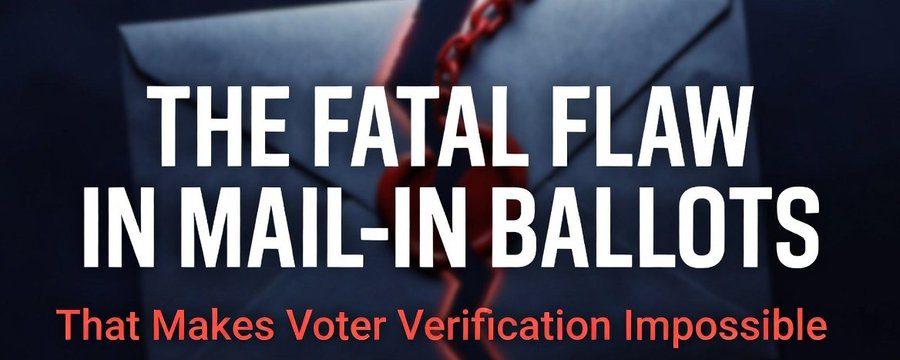
The Fatal Flaw in Mail-In Ballots That Makes Voter Verification Impossible

From the exact moment a mail-in ballot envelope is received, there is no possible way for anyone — or any technology — to determine who, or what, actually filled out that ballot.

This single fact destroys the foundation of mail-in voting.

The signature on the outer envelope, constantly promoted as the primary security measure, verifies absolutely nothing about who marked the votes inside the ballot. It cannot confirm that the registered voter filled out the ballot. It cannot even confirm whether a real, eligible voter had any involvement whatsoever. The ballot and signature could both have been produced by a third party or a machine with zero legitimate voter involvement — and the system has no ability to detect it.

This failure exists immediately upon receipt. The system was designed in a broken state.

The rapid separation of ballots from their envelopes is often used to dismiss later concerns, yet this misses the central truth: there was never any way to verify the voter to begin with. Signature verification and ballot separation are nothing more than security theater.

We have all been lied to.

Election officials, legislators, and the American people have been repeatedly told that mail-in ballots are secure. That claim is demonstrably false.

This becomes even more alarming when viewed through the lens law enforcement uses to evaluate serious crimes — Motive, Means, and Opportunity:

  • Motive: Total political power of over 330 million Americans and control of trillions in government spending.
  • Means: A system that is structurally incapable of verifying who or what cast any given ballot.
  • Opportunity: Mass mail-in ballots aggressively expanded across the entire country.

When all three align around our elections — the highest-value target in the republic — exploitation is not a risk, it is a certainty.

And it is already happening.

  • In Mesa County, Colorado, former postal worker Vicki Lyn Stuart was sentenced to five years in prison in June 2025 for stealing ballots, forging voter signatures, and fraudulently submitting mail-in ballots during the 2024 election.
  • In Iowa, Kim Phuong Taylor was convicted on 52 counts of voter fraud for filling out and forging signatures on absentee ballots belonging to other people.
  • In California, former Lodi City Councilman Shakir Khan was sentenced to three years in jail after authorities discovered dozens of completed mail-in ballots at his home.

These proven cases confirm the system is being actively exploited right now. Yet because of its design, we have no idea how large the fraud actually is because the true scale is completely undetectable and immeasurable.

This is a clear and present danger to the republic.

The continued use of mass mail-in ballots is national suicide. A voting system that cannot verify the identity or even the existence of the voter is not a minor policy issue — it is an existential threat to free and fair elections.

Mass mail-in ballots must be abolished immediately.

Our republic cannot survive if we cannot verify who is actually voting.

Call to Action: Share this article with your state legislators, your sheriff, and your local election officials. Demand the immediate abolition of mass mail-in ballots. The integrity of our elections depends on it.

The New Declaration