The Misleading Claim That Machines Are More Accurate Than Hand Counts
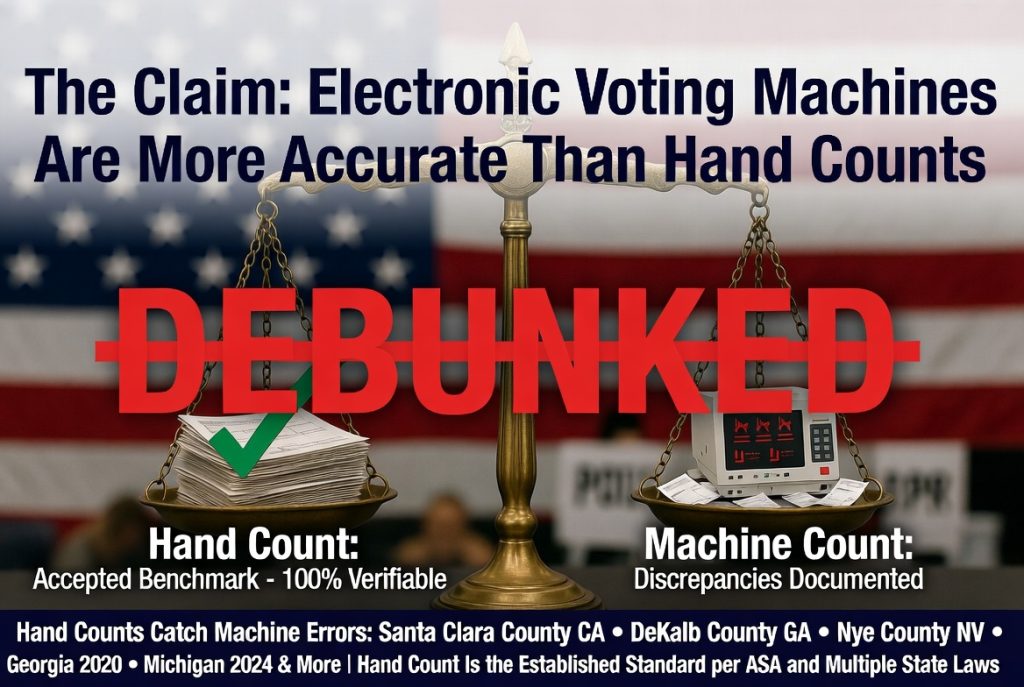
For years, organizations such as the Brennan Center for Justice, the Voting Rights Lab, the Bipartisan Policy Center, and others have promoted the narrative that electronic voting machines are more accurate than hand counting. This claim rests on flawed circular reasoning found in multiple academic studies.
A key example is the 2018 study “Learning from Recounts.” The researchers observed that when ballots originally counted by machine were recounted by machine, the average discrepancy was ‘only’ 0.13% to 0.15%. (That alone should raise alarm bells, that machines can’t even count votes accurately back to back). Then they go on to say when the same ballots were counted by hand, the discrepancy ‘increased’ to 1.8%. Rather than admitting that the machines had failed to accurately tabulate the ballots, the authors preposterously (mis)interpreted the larger gap as evidence that hand counting is less accurate.
This reasoning is absolutely fundamentally flawed. The American Statistical Association, in its official 2018 document “Principles and Best Practices for Post-Election Tabulation Audits,” clearly states:
“The benchmark of tabulation accuracy is what an accurate hand count of all ballots accepted for counting by the election authority would reveal.”
In other words, a proper hand count is the accepted standard against which machine accuracy must be judged. Several states reinforce this principle in their election codes. For example, Georgia’s risk-limiting audit law (O.C.G.A. § 21-2-498), Texas Election Code provisions, and the audit statutes in New Mexico and Minnesota all rely on manual hand counts of ballots to verify machine results. When discrepancies appear, the hand count serves as the de-facto reference point.
Some real-world examples where hand counts caught discrepancies in the original machine count:
- Santa Clara County, California – 2024: Hand review found 19 ballots that were never counted originally.
- Michigan statewide – 2024: Risk-limiting audit hand count of 119,567 ballots found a total discrepancy of 33 votes (0.03%).
- DeKalb County, Georgia – 2022: Machine tabulators showed her with zero votes in most precincts. Hand recount revealed she was shortchanged by 3,792 votes.
- Nye County, Nevada – 2022: Hand count caught votes missed by machines due to a 5% sensitivity threshold. The clerk stated the hand count was the more accurate result.
- Georgia statewide – 2020: Full hand audit found approximately 5,000 ballots that had not been tabulated in the original machine count.
- Iowa 2nd Congressional District – 2020: Hand-involved recount corrected 168+ votes and flipped the election outcome.
- Ware County, Georgia – 2020: Hand audit found 37 additional votes not counted by the machines.
- Butte County, Idaho – 2020: Hand audit found 9 extra votes missed by machines due to ballot sorting errors.
These cases demonstrate that hand counts have repeatedly identified errors that machine tabulators missed. Yet many studies and institutions continue to treat larger discrepancies between machines and hand counts as proof that hand counting is inferior, rather than acknowledging that the machines failed to match the established hand-count benchmark.
When two independent counts of the exact same ballots produce materially different results, logic dictates that at least one of them is inaccurate. The data consistently shows that machine counts frequently fail to match the hand-count standard.
The public deserves an honest assessment of these systems. The claim that machines are inherently more accurate than hand counts is not supported by either the data or the proper application of the accepted verification standard.
This pattern of deceptive research has persisted for years. Studies repeatedly use hand counts as the benchmark to test machines, then flip the results to claim the benchmark itself is flawed. This is not science — it is statistical sleight-of-hand designed to manufacture a predetermined conclusion. By citing these misleading studies, major institutions and election officials have deliberately undermined public confidence in hand counting while protecting the very systems that have repeatedly failed when measured against the hand-count standard. This is not science. It is statistical deception designed to protect flawed machines while discrediting the very method used to verify them.
The A-Count-Able Hand Count Tabulation Process produces a 100% Verifiably Accurate result, and is simple enough for a 6-year old to understand and perform. The argument is OVER. It’s time for common sense to be the adult in the room.