Burden Inversion: Has Everyone Lost Their Damn Minds?
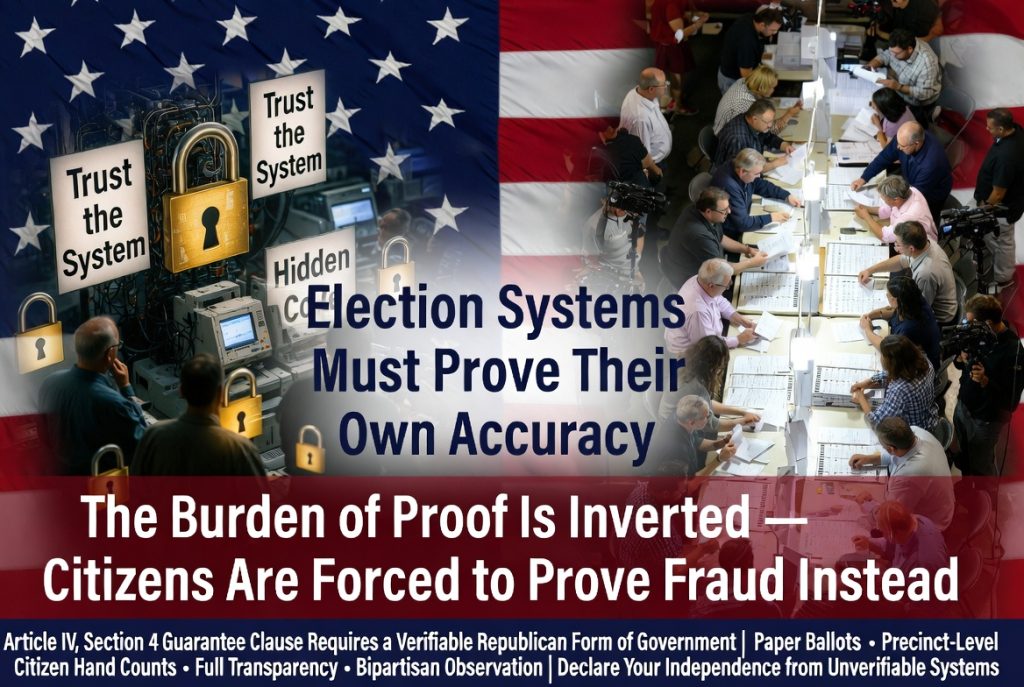
Our election systems do not produce results that can be independently verified as accurate. That single fact should alarm every American, yet instead of fixing the systems, we are told we must trust them. The burden of proof has been completely inverted. Citizens are expected to prove fraud after the results are announced, while the systems themselves face no requirement to prove they got it right. This is not a reasonable standard. It is madness.
A legitimate election system must do one thing above all else: produce results that can be transparently and independently confirmed to reflect only the will of eligible voters. This is not an opinion. It is a constitutional requirement.

Article IV, Section 4 of the United States Constitution
, the Guarantee Clause, commands that every state shall have a republican form of government. That form of government rests on the genuine consent of the governed. When the counting process is opaque and unverifiable, that consent cannot be confirmed. The system therefore fails the Constitution’s most basic test.
This inversion did not begin in 2020. It did not begin with any single candidate or party. For generations, both Democrats and Republicans have seen elections overturned because of proven fraud. Congress has thrown out results in contested House races on both sides of the aisle. The pattern is old, and the victims have come from both parties. James and Kenneth Collier documented this reality decades ago in their book Votescam.
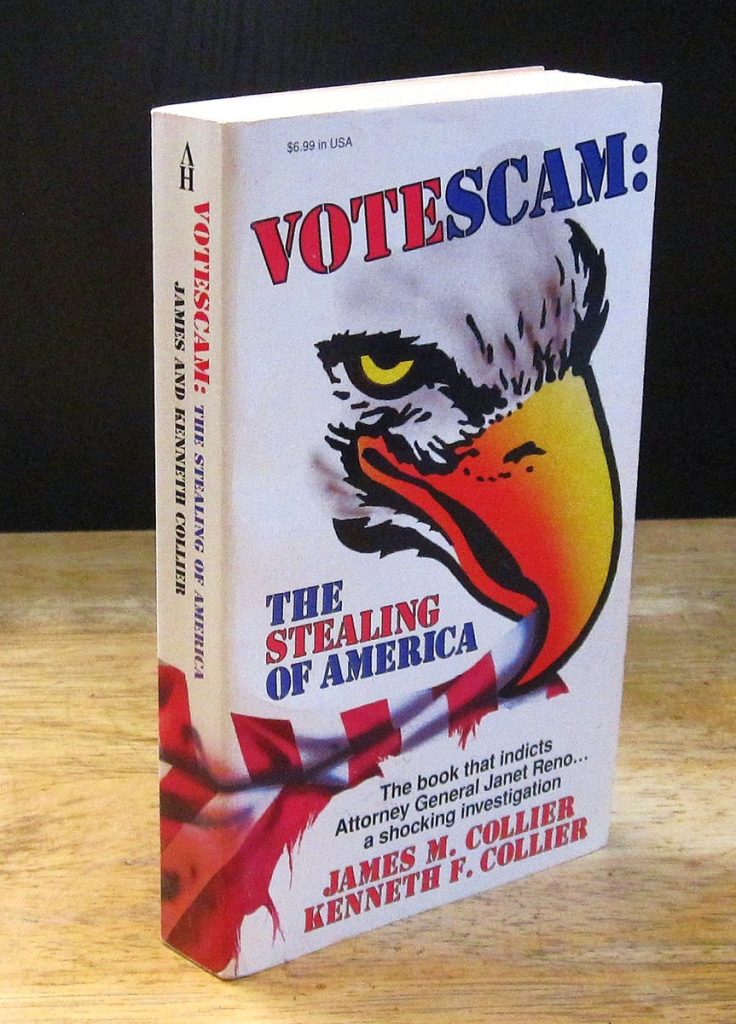
They exposed how early computerized voting systems created hidden opportunities for manipulation while removing the vote count from public view.
None of this happened by accident. Sophisticated actors deliberately channeled the public into an impossible task. Year after year, the same phrases were repeated with mechanical precision: “baseless claims,” “no evidence,” and “where’s the proof?” These words did not invite scrutiny of the systems. They forced citizens to chase an evidentiary burden that was designed to be unmeetable. Had the question been “Can this system prove its own results are accurate?” instead of “Can you prove fraud?” the entire debate would have collapsed within the first year.
The most obvious warning sign is the relentless demand that we simply trust the system. Institutions invest massive energy telling the public (including our own Election Officials) to have faith in the process. A system that truly works does not need to beg for trust. It earns trust by being transparent and verifiable. When perceived authorities must constantly demand belief rather than demonstrate proof, they are admitting the system cannot stand on its own.
Consider how sophisticated criminals operate. Modern car thieves do not pick locks with paper clips. They use electronic scanners to clone key fobs from a distance and sophisticated devices to bypass computer systems once inside the vehicle. The more complex the car’s technology, the easier it is for experts to defeat it while the average owner remains unaware. Our election systems have been built with that same dangerous complexity. They produce results that look official to citizens and election workers alike, yet those results cannot be independently verified by the people whose government is being chosen. If intelligent actors wanted to manipulate elections while maintaining the appearance of legitimacy, this is precisely the system they would design.
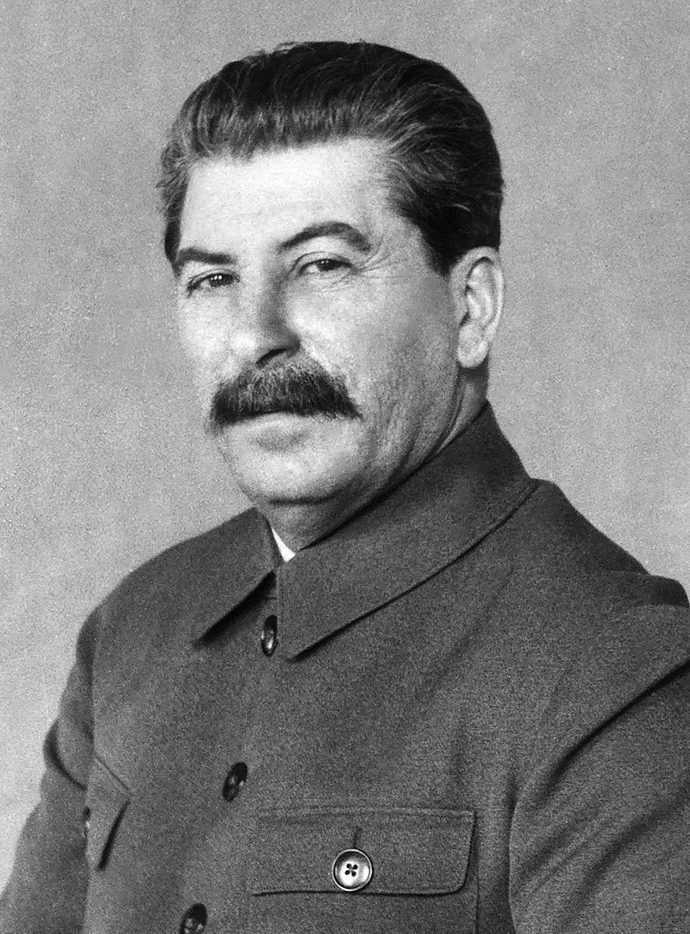
Joseph Stalin stated in 1923, “I consider it completely unimportant who in the party will vote, or how; but what is extraordinarily important is this—who will count the votes, and how.”
What would very intelligent, sophisticated, and evil people do if they wanted to take over a nation without firing a single shot? They would remove the people from the counting process. They would replace transparent paper ballots and public observation with complex electronic systems that only a handful of ‘experts’ truly understand. They would meticulously train the public to accept results on faith alone. It might even jail or imprison those that attempt to question it, like they have done with Tina Peters.

They would make any challenge to the system seem unreasonable or even dangerous. They would invert the burden of proof so completely that the people would spend years trying to prove fraud instead of demanding that the system prove its own accuracy.
That is not a conspiracy theory. That is a precise description of the system we have been living under.
The solution is not more accusations. The solution is to build systems that no longer require blind trust because their accuracy can be seen and confirmed by any citizen who cares to look. Secure, in-person paper-based voter registration managed only by our local county servants, Citizen-run precinct-level hand counts on election day, under bipartisan citizen observation, with immediate public posting of results. Strict limits on absentee ballots. Full transparency of every ballot image, video footage of the vote counting process, and chain-of-custody records. These are not radical ideas. They are the minimum requirements for a system that can actually prove it got the answer right every time.
Until we restore the correct burden, until the system itself must prove its accuracy, the Guarantee Clause remains unfulfilled. A republic that cannot verify its own elections is not a republic at all. It is simply an illusion of a republic.
The question is no longer — and never should have been — whether fraud occurred in any particular election. The question is whether we have all lost our damn minds by accepting systems that can never prove they are honest. The answer, unfortunately, appears to be yes.
So, are you ready to Declare Your Independence?